
 ChatGPT
 Perplexity
 Claude
 Grok
GrokChoosing between ContioReach and Contentful depends less on whether your team wants a headless CMS and more on what role the CMS needs to play in your content architecture.
Contentful is a broad, API-first content platform designed to manage structured content across websites, applications, digital experiences, and markets. It provides REST and GraphQL APIs, customizable content models, environments, localization, preview capabilities, webhooks, and an extensibility framework.
ContioReach takes a more focused approach. It is a headless CMS built specifically for blogs, with structured support for posts, authors, categories, tags, metadata, publishing, and blog-focused content workflows. Its Content API uses authenticated REST requests and is designed to work with frameworks including Next.js, Nuxt, Astro, SvelteKit, Remix, React, Vue, and Gatsby.
For a blog-focused company, the difference can be summarized simply:
Contentful gives developers a flexible content platform that can be modeled for many types of digital experiences.
ContioReach gives developers a blog-focused content layer that is already structured around publishing articles.
Contentful supports both REST and GraphQL delivery.
ContioReach uses a focused REST and JSON delivery model.
Contentful provides extensive content modeling and extensibility.
ContioReach reduces the amount of blog-specific infrastructure a team needs to design itself.
The right choice therefore depends on whether your blog is one part of a broader content ecosystem or the primary content operation you need to run.
ContioReach vs Contentful at a glance
Area | ContioReach | Contentful |
Primary focus | Blog-focused content management | General-purpose composable content |
Content modeling | Blog-oriented structure | Flexible custom content models |
API | REST Content API | REST and GraphQL APIs |
Frontend | Framework-agnostic | Framework-agnostic |
Preview | Frontend-controlled publishing architecture | Dedicated Content Preview API and preview workflows |
Webhooks | Publishing webhooks for cache revalidation | Webhooks and broader event-driven integrations |
Environments | Workspace-based separation | Dedicated environments for isolated development |
Localization | Blog content architecture | Mature locale and fallback model |
SEO/GEO | Built into the editorial workflow | Available through platform capabilities, apps, and integrations |
Blog publishing | Purpose-built | Configurable through content modeling |
Best fit | Teams primarily managing blogs | Teams managing varied structured content and digital experiences |
The distinction is how much of the content architecture your developers need to design themselves.
If you are moving from a traditional CMS, it is also worth understanding what changes for your blog when the content layer and frontend become separate systems.
What is the difference between ContioReach and Contentful?
Contentful is a general-purpose content platform that lets developers design their own content architecture. ContioReach is a blog-focused CMS that provides a more predefined architecture around publishing.
Contentful's content model is based on content types and fields. Developers can create relationships between content types and build a structure that matches the organization's requirements. Its APIs then expose that model to applications.
A Contentful implementation might model an article like this:
Article
├── title
├── slug
├── excerpt
├── body
├── author          → Author
├── category        → Category
├── tags            → Tag[]
├── relatedArticles → Article[]
├── product         → Product
├── feature         → Feature
├── featuredImage   → Asset
└── SEO             → SEO
That flexibility becomes useful when the article needs to become part of a larger content graph.
ContioReach starts from the blog use case. Its Content API exposes posts, categories, authors, and tags, with filtering, pagination, search, slug-based retrieval, and lightweight responses for listing pages.
The architectural question is therefore:
Do developers need to design a content system, or do they need a content system already designed around the blog?
That distinction is also central to choosing a headless CMS for your blog, because the right architecture depends on how much of the content system your team wants to define, configure, and maintain itself.
Contentful vs ContioReach for developers
For developers, the biggest difference is not whether the frontend can be separated from the CMS. Both platforms support decoupled architectures.
The bigger difference is content-modeling freedom versus blog-specific simplicity.
Contentful provides multiple APIs for different operations. Its platform includes REST APIs for delivery and management, a Content Preview API for unpublished content, and a GraphQL Content API whose schema is generated from the content model.
ContioReach provides an authenticated Content API designed around published blog content. Developers can retrieve posts, filter by category, tag, or author, search posts, retrieve a post by slug, and use lightweight responses for listing pages.
Developer consideration | ContioReach | Contentful |
REST API | Yes | Yes |
GraphQL API | Not currently its primary delivery model | Yes |
Content schema | Blog-focused | Developer-defined |
Article model | Predefined around blogs | Configured through content types |
Authors/categories/tags | Native blog entities | Custom content types/references |
Custom relationships | More focused | Extensive |
Webhooks | Publishing/revalidation workflow | Supported |
Preview | Product-specific workflow | Dedicated Preview API |
Environments | Focused product architecture | Strong environment model |
Extensibility | Focused | App Framework |
Framework dependency | None | None |
Contentful's GraphQL API generates a schema based on the current content model, allowing developers to query structured content and references according to the schema they have created.
ContioReach deliberately keeps the API surface narrower. Its documentation states that no SDK or frontend framework is required and that any application capable of making HTTP requests and handling JSON can consume the API.
For developers, that creates a straightforward trade-off.
Contentful gives you more control over the shape of the content system. ContioReach gives you a more predefined system for the specific job of powering a blog.
How do ContioReach and Contentful handle content modeling?
Contentful gives developers more freedom to design schemas, while ContioReach reduces schema work by centering its model around blog content.
This matters when deciding whether the blog should remain a standalone content operation or become part of a larger content graph.
A Contentful team can create custom content types for articles, authors, products, features, resources, landing pages, campaigns, and other entities. Those entries can then be connected through references. Contentful's own Plaid case study highlights reusable content types and references as an important part of the company's implementation.
A blog-focused system takes a different approach.
Instead of asking developers to decide how an article should relate to every possible business object, the CMS starts with the objects a blog typically needs.
That can reduce initial modeling work, but it also means there is less reason to expect the blog CMS to become a universal content database.
When does flexible content modeling matter?
It becomes more important when the same content needs to appear in multiple experiences.
For example:
Product → Feature → Article → Related articles → Resource hub
If those relationships become central to the website architecture, a highly customizable content model can provide more control.
If the main relationships are:
Article

├── Author
├── Category
├── Tags
└── Related Articles
a blog-specific structure can be sufficient.
This is one reason developers should evaluate the content graph they actually need, rather than simply counting CMS features.
How does the CMS affect your blog frontend?
The CMS provides the content layer. Your frontend framework still controls routing, rendering, caching, performance, and presentation.
Both ContioReach and Contentful can be used with a decoupled frontend.
A typical architecture looks like this:
Content team → Headless CMS → API → Frontend → CDN / hosting → Reader
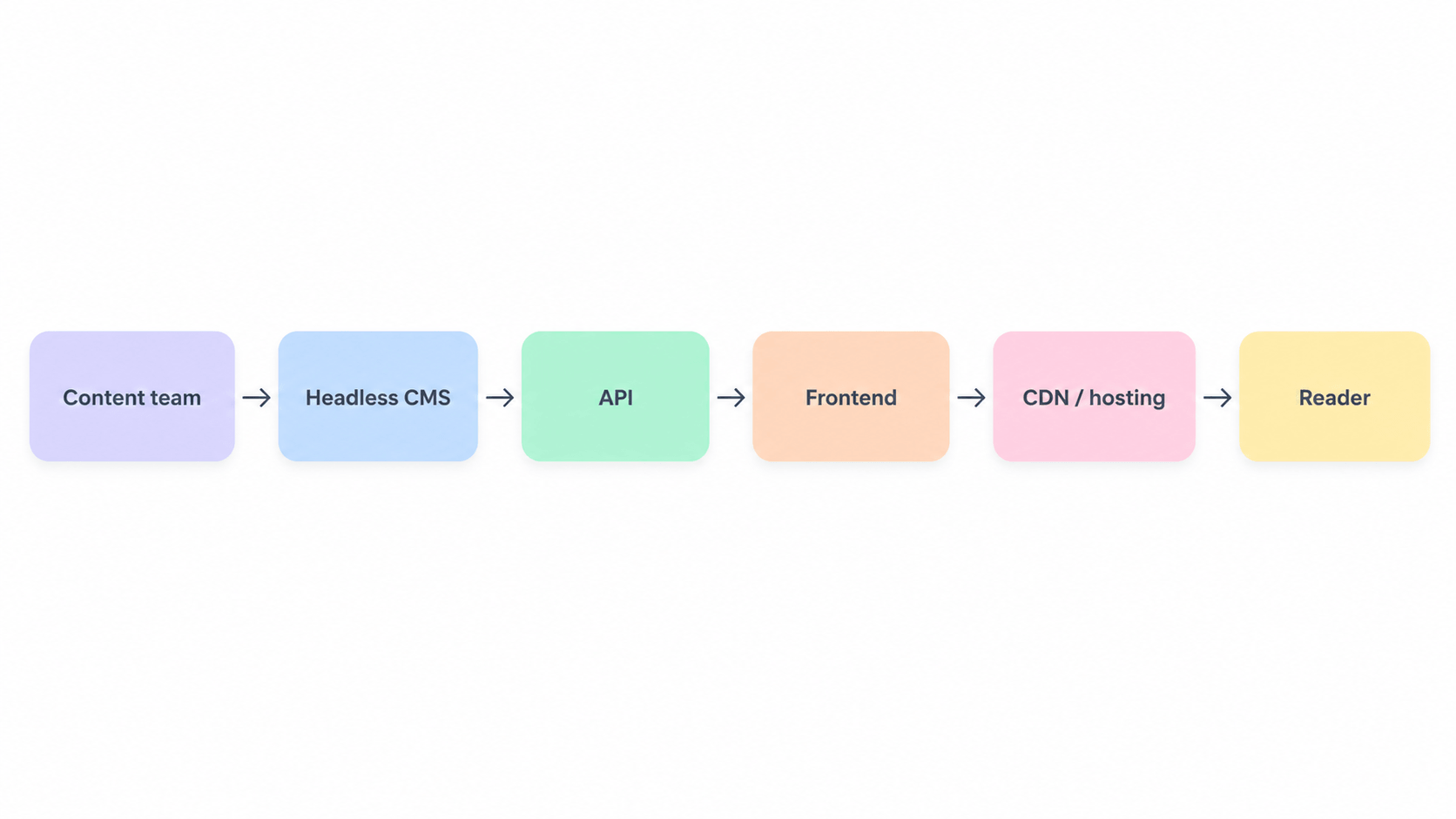
The CMS therefore does not determine whether developers use Next.js, Astro, Nuxt, React, Vue, or another framework.
ContioReach explicitly documents integrations for Next.js, Nuxt, Astro, SvelteKit, Remix, React, Vue, and Gatsby, with framework-specific examples for caching and publishing webhooks.
Contentful similarly operates as a content layer rather than a required frontend rendering system.
That separation gives developers control over:
URL structure
routing
server-side rendering
static generation
incremental regeneration
caching
CDN configuration
image handling
structured data
page templates
frontend components
The CMS is responsible for making structured content available.
The frontend decides how that content becomes a page.
How do APIs, webhooks, and caching work?
The API retrieves content. Webhooks tell your application that content changed. Caching determines how efficiently the frontend serves that content.
This is one of the most important technical considerations for developers.
ContioReach documents a publishing workflow where an article change can trigger a webhook, allowing the frontend to invalidate or refresh the affected content. Its framework documentation describes using cache tags such as blogs and blog-[slug] to revalidate only the content that changed.
That creates a useful architecture:
ContioReach
    │
    │  publish webhook
    ↓
Your application
    │
    ├── verify webhook
    │
    └── invalidate affected cache
            ↓
        CDN / server
            ↓
         Reader
This approach is particularly useful for statically generated or cached blogs.
Contentful also supports webhooks and provides multiple APIs for delivery, management, and preview, allowing developers to construct broader event-driven publishing workflows.
The important point is that a headless CMS does not automatically determine website performance.
Your implementation still controls:
API request frequency
cache duration
cache invalidation
rendering strategy
payload size
image optimization
CDN behavior
frontend JavaScript
ContioReach's API supports a minimal response option that omits the article body for listing pages, helping developers request only the content required for a collection view.
That is a small implementation detail, but these details matter when a blog has hundreds or thousands of articles.
How should developers handle CMS API security?
CMS API credentials should remain on the server side unless the API is explicitly designed for public client-side access.
ContioReach requires an API key for Content API requests and recommends storing that key in a server-side environment variable rather than exposing it in browser JavaScript or public environment variables.
A typical setup is:
Browser
   ↓
Your server / API route      ← API key stays here
   ↓
ContioReach Content API
   ↓
Structured JSON
The browser should not receive the private CMS credential.
This distinction is particularly important for teams using frameworks such as Next.js, where environment variables can intentionally be exposed to browser code if configured incorrectly.
Contentful also separates delivery, management, and preview APIs, giving developers different API surfaces for different content operations.
When comparing a CMS, developers should therefore examine:
authentication methods
delivery credentials
management credentials
preview access
environment-specific keys
webhook verification
server-side versus client-side requests
These details are more important than simply asking whether a CMS "has an API."
How do preview and production workflows differ?
A production blog needs a clear separation between draft content, preview content, published content, and cached production pages.
Contentful provides a dedicated Content Preview API that can retrieve unpublished content for preview environments. Its documentation describes using preview access tokens with a preview deployment so editors can see draft content in context.
Its GraphQL API also supports preview behavior, including retrieving non-published content and resolving references in preview mode.
The architectural flow looks like:
Preview:     Draft → Preview API → Preview frontend → Editorial review
                                                              ↓
Production:  Publish → Production API → Production frontend
This matters because content preview is not simply an editor feature.
It affects the architecture of the application itself.
Developers need to decide:
Where preview requests are handled.
Which credentials can access drafts.
How preview routes are protected.
How unpublished content is excluded from production.
How caches are separated between preview and production.
When comparing Contentful with a blog-focused CMS, preview behavior should therefore be evaluated as part of the deployment architecture.
How do environments affect development?
Contentful provides environments that allow teams to isolate development and testing changes from other environments. Developers can work with environment-specific content models and entries rather than treating one production content space as the only working environment.
That becomes valuable when engineering teams have formal workflows such as:
Development → QA → Staging → Production
For a large engineering organization, the ability to isolate changes can reduce the risk of modifying production content models while another team is testing a feature.
A blog-focused CMS may take a more opinionated approach because the content model itself is narrower.
The key question is not whether one environmental system is "better."
It is:
How much content infrastructure does your engineering workflow require?
A small team launching one blog may not need the same environment architecture as an enterprise organization operating multiple digital properties.
How does localization affect the CMS architecture?
Localization becomes a technical CMS concern when the same content must exist across multiple languages, URLs, metadata sets, and publishing workflows.
Contentful supports localized entries and fields, including locale fallback behavior. Its documentation describes requesting content by locale and configuring fallback locales when localized content is unavailable.
For a multilingual blog, the architecture may look like:
Article

├── en-US
├── de-DE
├── fr-FR
└── ja-JP
But developers still need to solve several frontend problems:
localized URLs
translated slugs
metadata per locale
hreflang
language routing
locale fallback
translated internal links
localized structured data
publishing state by language
A CMS can provide the underlying content model, but the frontend still has to implement the language experience correctly.
For organizations with extensive international content operations, Contentful's localization model can therefore become an important architectural consideration.
For a blog primarily operating in one language, that additional complexity may be less relevant.
ContioReach vs Contentful for content teams
For content teams, the question is less about API capability and more about how much of the publishing operation happens inside the CMS.
ContioReach puts blog creation, metadata, SEO/GEO optimization, expert review, semantic internal linking, publishing, and search workflows closer together. Its current product documentation describes optimization directly inside the editor and a workflow that moves from creation through review, optimization, linking, publishing, and measurement.
Contentful provides a broader editorial platform with structured content, roles, localization, preview, and extensibility. Its App Framework allows teams to extend the editorial environment with applications and integrations.
This creates two different operating models.
Contentful: build the blog workflow around a flexible content platform.
ContioReach: use a content platform already shaped around running a blog.
For writers and editors, that difference can affect how many configuration steps happen before an article is ready to publish.
Which CMS is easier for managing a blog?
For a team whose primary CMS requirement is running a blog, a more opinionated blog model can reduce setup and content-modeling work.
A typical blog team needs to:
Create and update articles.
Manage authors and taxonomies.
Add metadata.
Connect related content.
Optimize articles.
Schedule publication.
Keep content structured for the frontend.
Monitor search visibility.
Update older content.
ContioReach brings many of these activities into the same blog workflow. Its editor keeps article content, authors, categories, tags, metadata, optimization, linking, and publishing connected.
Contentful can support the same type of blog, but the organization has more control over how the underlying content architecture is modeled.
That difference can be valuable when a content team has unusual requirements.
It can also mean more configuration.
The relevant question is therefore not simply "which CMS has more features?"
It is which CMS leaves fewer gaps between the way your team wants to work and the system they have to configure.
Contentful alternative for blogs: what should you compare?
If you are evaluating a Contentful alternative for blogs, avoid comparing platforms only by API availability or whether they are technically headless.
A blog-focused evaluation should include the operational layer around the API.
What should content teams evaluate?
Content modeling
Can developers create the structure they actually need without unnecessary schema work?Editorial workflow
Can writers and editors work without understanding the underlying architecture?SEO workflow
Are metadata, internal linking, indexing, and content optimization integrated into the publishing process?Developer integration
Can the frontend consume structured content without adopting a proprietary rendering layer?Performance architecture
Can developers control caching, rendering, payload size, and revalidation?Content maintenance
Can teams update and improve existing articles without engineering tickets?Governance
Can the platform support the roles, permissions, environments, and workflows the organization actually needs?
This last point is especially important because a CMS can be technically impressive while still creating unnecessary operational complexity for a blog team.
ContioReach vs Contentful for SaaS
For SaaS teams, the deciding factor is usually how central the blog is to the wider content architecture.
A SaaS company may need its CMS to support:
Blog articles
Product pages
Feature pages
Solution pages
Customer stories
Resource hubs
Campaign pages
Documentation
Localization
Personalized experiences
If all of these need to share one highly connected content graph, Contentful's broader modeling capabilities become more relevant.
If the CMS primarily needs to power a sophisticated blog while developers control the frontend, a blog-focused architecture can reduce the amount of content infrastructure the engineering team has to design.
SaaS requirement | ContioReach | Contentful |
Custom blog frontend | Yes | Yes |
Framework independence | Yes | Yes |
Structured article API | Native | Configurable |
Custom content types | More limited by product focus | Core capability |
Complex references | Blog-focused | Extensive |
Localization | More focused | Extensive |
Environments | Focused | Extensive |
Blog SEO workflow | Core focus | Configurable |
Broader content infrastructure | More focused on blogs | Core platform strength |
Multi-channel content | Blog-focused API | Core platform capability |
Plaid Case Study
Plaid provides a useful real-world example of Contentful being used to move content operations beyond a developer-maintained static website.
According to Contentful's customer story, Plaid had a 200-page static marketing site that required technical expertise to edit and launch. After adopting Contentful, the company scaled to more than 770 pages of Contentful-powered content while the same four developers supported the expanded site. Plaid subsequently migrated its blog to Contentful.
The example is useful because it demonstrates what a general-purpose headless CMS can do when marketing content becomes a larger part of the web architecture.
It also illustrates why the decision should not be based solely on the blog editor.
If your SaaS website needs the CMS to become a broader content infrastructure layer, Contentful's flexibility can be important.
If the blog remains a specialized acquisition channel, a blog-focused architecture may solve a narrower problem with less modeling overhead.
Contentful vs ContioReach API: what is different?
The API is one of the clearest technical differences.
Contentful provides multiple API surfaces. Its documentation distinguishes the Content Delivery API, Content Management API, Content Preview API, Images API, and GraphQL Content API.
Its GraphQL API generates a schema from the content model and can expose content from specific environments.
ContioReach provides a focused REST Content API.
Its documented endpoints include:
GET /v1/blogs
GET /v1/categories
GET /v1/authors
GET /v1/tags
The posts endpoint supports pagination, category filtering, author filtering, tag filtering, keyword search, slug retrieval, and lightweight responses for collection pages.
API consideration | ContioReach | Contentful |
REST | Yes | Yes |
GraphQL | Not currently its primary delivery API | Yes |
Blog retrieval | Native | Based on content model |
Authors | Native | Custom model/reference |
Categories | Native | Custom model/reference |
Tags | Native | Custom model/reference |
Custom schema | More opinionated | Highly configurable |
Preview API | Product-specific | Dedicated API |
Webhooks | Publishing/revalidation | Extensive |
Environments | Focused | Extensive |
For developers, the choice comes down to the application architecture.
If you need a broad content graph with multiple query patterns, Contentful gives you more control.
If you need a structured blog API with common blog entities already defined, ContioReach provides a narrower integration surface.
SEO and AEO differences between ContioReach and Contentful
A CMS does not make a blog rank by itself.
The frontend still needs crawlable URLs, indexable content, useful internal links, appropriate metadata, good page experience, and technically sound implementation.
Google's current guidance is especially relevant here. Google states that its existing SEO best practices remain foundational for AI Overviews and AI Mode, and that there are no additional technical requirements specifically for appearing in those AI features.
Google's 2026 guidance also emphasizes valuable, unique, people-first content rather than content created primarily to manipulate search visibility.
That changes how teams should think about AEO.
AEO is not a separate CMS requirement
A useful AI-search-ready article should:
Answer important questions directly.
Use clear heading hierarchy.
Explain concepts without unnecessary ambiguity.
Support factual claims with reliable sources.
Provide original analysis or experience.
Make important information easy to extract.
Remain useful to a human reader.
Google also requires pages to meet the normal technical requirements for Search to be eligible for AI features, including being accessible to Googlebot, returning a successful response, and containing indexable content.
ContioReach places SEO and GEO guidance directly in the content workflow, including structure, headings, metadata, clarity, internal connections, and answer-oriented content improvements.
Contentful can support the same SEO architecture, but teams may assemble those workflows through content models, frontend logic, applications, integrations, and other tools.
Search visibility also needs measurement
Google introduced dedicated Search Console reporting for visibility from generative AI features in 2026, providing reporting for AI Overviews, AI Mode, and other generative AI experiences. Google announced that these insights had rolled out worldwide by August 31, 2026.
That makes the CMS workflow increasingly connected to the broader content measurement process.
The important distinction is:
The CMS can make optimization and measurement easier. It cannot guarantee rankings, AI visibility, or citations.
Contentful vs ContioReach for marketing teams
Marketing teams typically care about speed, autonomy, discoverability, governance, and how much engineering capacity content operations consume.
Contentful's strength is its ability to support a broader structured-content operation. Its roles, environments, localization, APIs, content models, and extensibility allow organizations to build workflows around different teams and digital experiences.
ContioReach concentrates more of its product surface around the blog itself.
Its content workflow connects writing, expert review, SEO/GEO optimization, semantic internal linking, publishing, and search-related workflows.
For a marketing team, the distinction is therefore:
Contentful: build the content operation around a flexible platform.
ContioReach: run the blog operation inside a platform already shaped around blogging.
That distinction can reduce the number of handoffs between writers, editors, SEO specialists, and developers.
What about agencies managing multiple blogs?
Agencies have a different operational challenge because they may manage multiple brands, websites, teams, and publishing workflows.
A multi-client setup needs more than an API.
It needs separation between content, users, permissions, configuration, and publishing operations.
ContioReach provides workspaces that keep content, teams, and configuration separated between different blog operations. Its documentation describes independent content and team access by workspace.
Contentful provides broader organizational and environment capabilities for teams managing structured content across larger digital ecosystems.
For an agency, evaluate:
Number of brands.
Number of websites.
Workspace separation.
Client-specific permissions.
API credentials.
Publishing controls.
Localization requirements.
Development and staging workflows.
Migration requirements.
SEO and content reporting.
An agency managing primarily blogs may value standardized blog operations.
An agency building full digital experiences may need the broader modeling and extensibility of a general-purpose content platform.
That is also why comparisons like ContioReach vs Ghost should be treated differently from comparisons with developer-oriented headless platforms.
Contentful alternatives for blog-focused content teams
Contentful is one option in a broader headless CMS landscape.
Other platforms approach the problem differently.
Sanity emphasizes flexible structured content and customizable editing experiences. Strapi takes an open-source, developer-oriented approach. Ghost is strongly focused on publishing. Payload provides a code-oriented CMS architecture that gives developers substantial control.
The important point is that these platforms should not be evaluated against Contentful using one generic feature checklist.
Instead, identify the architecture your blog actually needs.
Priority | What to evaluate |
Developer control | API flexibility, schema control, frontend independence |
Content-team autonomy | Editorial workflow and publishing |
SEO operations | Metadata, internal linking, indexing, content maintenance |
Complex content | Relationships, references, custom models |
International publishing | Localization and translation workflows |
Agency operations | Workspaces, roles, permissions |
Enterprise governance | Environments, permissions, integrations |
Blog-first operation | Article structure and publishing workflow |
Performance | Caching, rendering, API payloads, revalidation |
If the comparison is primarily between headless CMS options, the developer trade-offs become more specific.
How should developers and marketers evaluate the two CMS platforms?
The best evaluation is not a feature-count exercise.
Start with the workflow your team needs to run every week.
For developers
Evaluate:
How much content modeling is required before launch?
Which APIs does the application need?
Is REST enough, or does the team need GraphQL?
How are drafts and previews handled?
How are environments separated?
How are publishing events delivered?
How will cache invalidation work?
How are API credentials protected?
How much custom infrastructure must engineering maintain?
For SEO teams
Evaluate:
How are titles and metadata managed?
How does the team create internal links?
How are articles prepared before publication?
How are indexing problems identified?
Can search data inform content maintenance?
Can technical SEO requirements be controlled from the frontend?
For marketing teams
Evaluate:
Can writers publish without developers?
Can content be scheduled?
Can teams collaborate?
Can older articles be updated efficiently?
How much work happens inside the CMS?
How many external tools are needed?
For agencies
Evaluate:
Can client environments remain separated?
Can permissions be customized?
Can multiple blogs be managed efficiently?
Can developers standardize frontend integrations?
Can the editorial workflow be reused across clients?
The goal is to identify where operational work happens, not which platform has the longest feature list.
ContioReach vs Contentful: which architecture fits your blog?
The practical difference comes down to scope.
Contentful is a flexible content platform that can power blogs alongside other digital experiences. It supports custom content models, environments, localization, references, REST and GraphQL APIs, and extensive integrations.
ContioReach is a blog-focused headless CMS built around the blog as the core content operation. It provides structured blog content through an authenticated REST API, with native posts, categories, authors, tags, filtering, pagination, search, publishing webhooks, and framework guidance.
For content and SEO teams, ContioReach brings creation, review, optimization, internal linking, and publishing into one workflow. For developers:
Contentful gives you more freedom to build the content system. ContioReach gives you a predefined system built around blogs.
If your blog sits within a broader content ecosystem, Contentful's flexibility may suit complex modeling, localization, environments, and integrations.
If your team primarily needs to run a modern blog while developers control the frontend and content teams manage publishing, ContioReach offers a more specialized setup.
When choosing a headless CMS, evaluate the full lifecycle. The right fit depends on which parts your CMS should handle directly.