 ChatGPT
 Perplexity
 Claude
 Grok
GrokA webhook pushes data to you the moment something happens, while an API waits for you to ask for it. That's the short answer, but there's more to it once you start building with either one, and the difference shapes how you architect an entire integration.
I get asked this question constantly, especially by people who are new to automation and integrations. The terms get thrown around interchangeably, but they solve different problems and show up in different parts of a workflow. In this guide, I'll walk through what each one actually does, how they're different, when I'd reach for one over the other, and where they end up working together on the same project.
What Is an API?
An API, short for Application Programming Interface, is a set of rules that lets two applications talk to each other. Think of it as a menu at a restaurant. You pick what you want, place the request, and the kitchen sends back a response.
With an API, your app is in control. You decide when to ask for data, what to ask for, and how often. If you want updated information, you send another request. This is called a pull model, because your app is pulling the data it needs.
APIs are everywhere. Weather apps use them to pull the latest forecast. Payment platforms use them to check account balances. Most of the software you use daily is talking to some API in the background, even if you never see it happen.
What Is a Webhook?
A webhook flips that relationship around. Instead of your app asking for data, the other application sends it to you automatically the moment something happens. You don't request it. It just arrived.
To set one up, you give a service a URL, called an endpoint, and tell it which events you care about. When that event happens, like a form submission or a completed payment, the service sends the data straight to your URL. This is called a push model, since the data is being pushed to you.
Webhooks are event driven. They stay quiet until something worth reporting occurs, then they fire off a message right away. That makes them useful for real time updates without constantly checking for changes.
Webhook vs API: The Core Difference
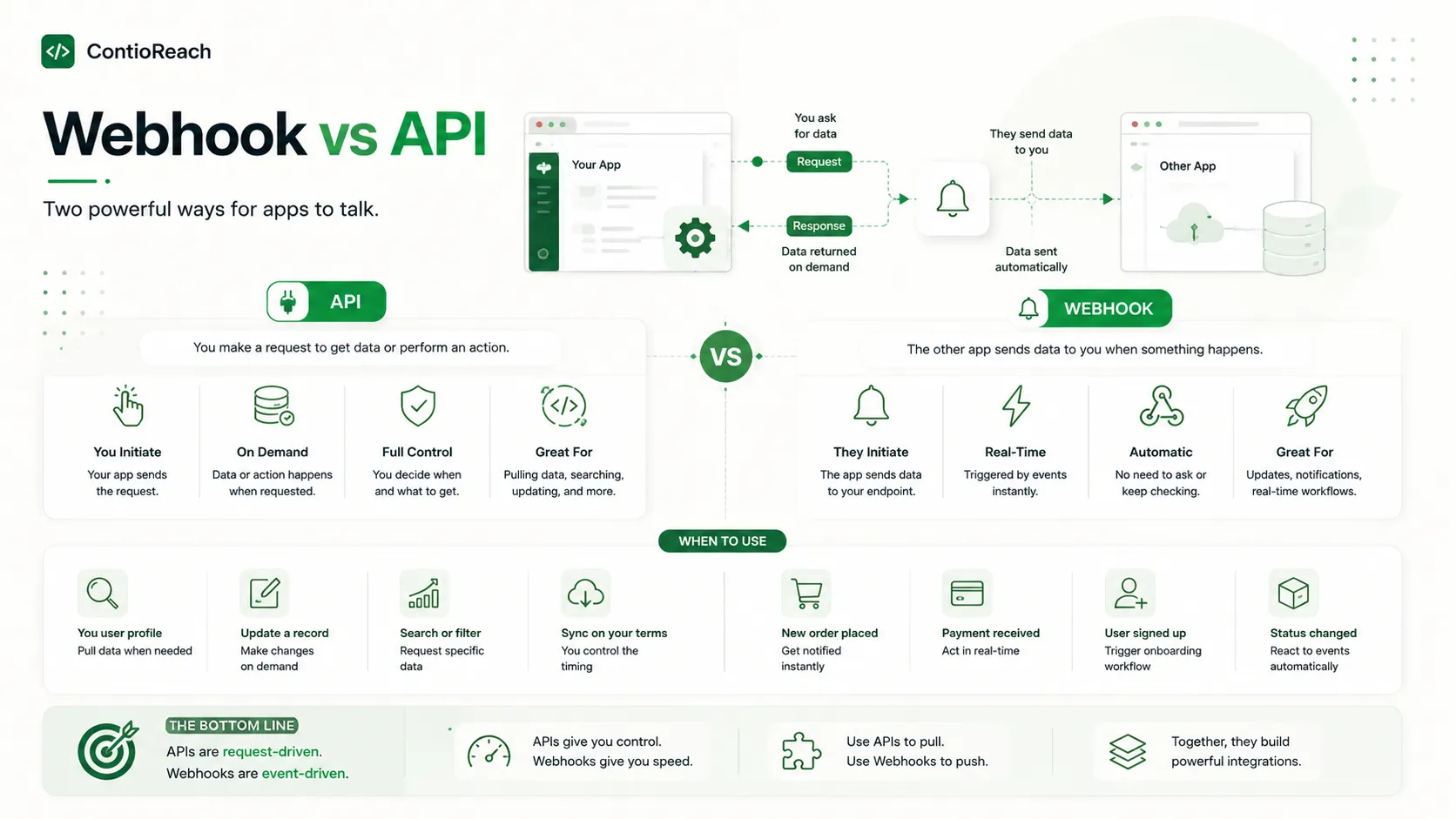
The easiest way to understand a webhook vs API is direction. An API is something you actively call to get information. A webhook is something that calls you, without you asking first.
Here's a side by side breakdown of how they compare.
Factor | API | Webhook |
Direction | Pull, you request data | Push, data is sent to you |
Trigger | You decide when to ask | An event decides when it fires |
Communication | Two way, ongoing | One way, single message |
Best for | On demand data, complex actions | Real time notifications |
Resource use | Can require repeated checking | Sends only when needed |
Something worth knowing: a webhook is technically a type of API call. It still uses the same HTTP protocol underneath. The real webhook vs API distinction is about who starts the conversation, not about completely separate technology.
How They Work Together
Most modern systems don't pick just one. They use both, and each one covers what the other doesn't do well.
A common setup looks like this: a webhook notifies your app the second an order is placed. Then, once your app has that notification, it uses an API to pull additional details, like the customer's full order history or shipping preferences. The webhook handles the "something happened" part. The API handles the "give me more information" part.
This combination shows up constantly in e-commerce platforms, CRM tools, and marketing software. Understanding this relationship is where the API vs webhook conversation becomes less about choosing sides and more about knowing which tool fits which job.
When to Use an API vs a Webhook
Choosing between them comes down to what you're trying to accomplish. If you need information on demand, or you need to send a complex request with multiple parameters, an API is the right call. If you need to react instantly when something happens, a webhook fits better.
Here's a quick reference to make the decision easier.
Scenario | Use This |
Checking current inventory levels | API |
Getting notified the instant a payment clears | Webhook |
Pulling a customer's full order history | API |
Triggering an automation when a form is submitted | Webhook |
Running a complex search query | API |
Sending a real time alert for a system outage | Webhook |
An API sends data when your app requests it, while a webhook sends data on its own the moment an event happens. That distinction is really the whole decision in one sentence.
Common Examples You've Probably Already Used
Payment processors are a good example of both working side by side. You might use an API to check a transaction's status whenever you want. But you'd use a webhook to get notified instantly when a payment succeeds or fails, instead of checking over and over.
Messaging platforms work the same way. An API lets your app send a message whenever you choose. A webhook lets your app know the second a reply comes in, without polling the platform every few seconds to check.
Content platforms and CMS tools follow this same pattern too. An API might pull a list of published articles on request. A webhook can notify a connected tool the moment a new post goes live, so downstream systems update automatically without manual checking.
Where ContioReach Fits Into This
This is exactly the kind of integration logic that matters for content teams managing multiple platforms at once. ContioReach uses API based connections for Auto-Publish and Internal Linking, so content moves where it needs to go without manual copying and pasting between tools.
If you're mapping out a content workflow and trying to decide where webhooks or APIs fit into it, ContioReach's platform is built around these same integration principles, keeping publishing, keyword planning, and internal linking connected without extra manual steps.
Final Thoughts
Getting clear on webhook vs API isn't about picking a winner. It's about matching the right tool to the right job. Pull when you need control over the request. Push when you need speed and don't want to keep checking for updates.
Once this clicks, a lot of how modern software connects together starts making a lot more sense.
FAQs
Is a webhook better than an API?
Neither is better on its own. A webhook is faster for real time alerts, while an API gives you more control and lets you request exactly the data you need, whenever you need it.
What is a webhook example?
A payment platform sending your app an instant message the moment a transaction clears, without your app having to check for updates first.
What are the disadvantages of webhooks?
They only send data one way, so you can't ask follow up questions through the same channel. If your endpoint goes down, you can also miss the notification unless the sender retries it.
Is a webhook just a POST API?
Not exactly. A webhook is a user defined HTTP callback that's triggered automatically when something happens, and it typically arrives as an HTTP POST request. Calling it "just a POST API" misses the event driven trigger, which is what actually separates it from a standard API call.
Written by

Team Contioreach
Creates expert content on SEO, AI search, content strategy, and automation to help businesses grow their online visibility.