 ChatGPT
 Perplexity
 Claude
 Grok
GrokFor most content agencies, growth creates a strange kind of pressure. More clients should mean more revenue, but it often just means more deadlines, more late nights, and more posts that never quite get finished. This content automation case study looks at one agency that hit that wall hard, publishing only two posts a month despite a growing client list, and how they broke through it.
Their story is a familiar one for any content team feeling stretched thin. What changed was not a bigger team or a longer workday. It was a shift in how content actually got made, and the results are worth understanding if your own output has quietly stalled.
The Agency Behind This Story
The agency at the center of this case study is a mid-sized content and SEO shop serving clients across e-commerce, SaaS, and local services. Sarah Okonkwo, their Content Director, had spent over a year watching her team fall further behind. Client onboarding was steady. Writer capacity was not.
"We were turning away good clients because we knew we could not keep up," Sarah recalls. "Two posts a month per client was our ceiling, and even that took everything we had."
The agency was not short on talent. Writers were skilled, editors were sharp, and the strategy behind every piece was sound. The bottleneck was purely operational: research took hours, briefs were inconsistent, and every post moved through the same slow, manual pipeline regardless of how simple the topic was.
Why Manual Content Production Hits a Ceiling
Most agencies reach this same point eventually. A single blog post, done properly, involves keyword research, outlining, drafting, editing, formatting, and publishing. When every one of those steps is manual, output scales in a straight line with headcount. Add more clients, and you either hire more people or slow down.
Sarah's team tried the usual fixes first. They brought on a freelance writer. They built content templates in shared docs. They tightened their editorial calendar. Each change helped a little, but none addressed the real issue: too much time was spent on repetitive groundwork instead of the strategic thinking that actually made content perform.
By the time Sarah started looking for a real solution, the agency was capping new client intake just to protect the quality of existing work. That is not a growth strategy. It is survival mode.
There was also a quieter cost that rarely shows up in a spreadsheet: writer burnout. Talented team members were spending most of their week on research and formatting instead of the strategic work they were actually hired for. Turnover risk climbs fast in that environment, and replacing a skilled content writer takes months, not weeks. Sarah's team was one resignation away from a much bigger problem than a publishing backlog.
The Search for a Content Automation Solution
Sarah's team evaluated several approaches before landing on a decision. Some tools promised speed but produced generic, unusable drafts that needed a full rewrite. Others handled writing but ignored SEO structure entirely, leaving the team to manually check keyword placement, headings, and internal links after the fact.
What the agency actually needed was a platform that understood the full content workflow, not just one piece of it. Keyword research, brand voice consistency, SEO scoring, and publishing all needed to work together, or the team would just be trading one bottleneck for another.
This is where ContioReach entered the picture.
Choosing ContioReach
Sarah's team piloted ContioReach on two client accounts to see whether it could handle real client work, not just a demo scenario. The platform's Keyword Planner gave the team validated topic and keyword data upfront, cutting out hours of manual research per post. Its Brand Voice feature let each client's tone stay consistent even as output increased, which mattered enormously given how differently their SaaS and e-commerce clients needed to sound.
The SEO Score feature became part of the team's internal quality check, flagging structural issues before a draft ever reached an editor. And Auto-Publish removed the final manual step of formatting and uploading finished posts, a task that Sarah says used to eat up an afternoon every week on its own.
"The first time we ran a full post through the platform, start to finish, in under an hour, I honestly did not believe it," Sarah says. "We checked it twice before sending it to the client."
How Implementation Actually Worked
The rollout was gradual and deliberate. Sarah's team did not switch every client over at once. They started with two accounts, refined their internal process, then expanded from there over six weeks.
Workflow Stage | Before ContioReach | After ContioReach |
Keyword research | 2 to 3 hours per post, manual tools | Minutes, using Keyword Planner |
Brand voice consistency | Inconsistent across writers | Maintained automatically via Brand Voice |
SEO structure check | Manual review before publishing | Automated via SEO Score |
Publishing | Manual formatting and upload | Automated via Auto-Publish |
Posts per client per month | 2 | Unlimited, based on client demand |
This kind of shift reflects the workflow change agencies commonly see when they move from a fully manual process to an integrated platform like ContioReach.
What stood out to Sarah was not any single feature, but how the pieces worked together. "We were not just doing the same work faster," she explains. "We stopped doing a lot of the repetitive work entirely, which meant our actual writers could focus on strategy and quality instead of formatting and research."
Results: From 2 Posts to Unlimited Output
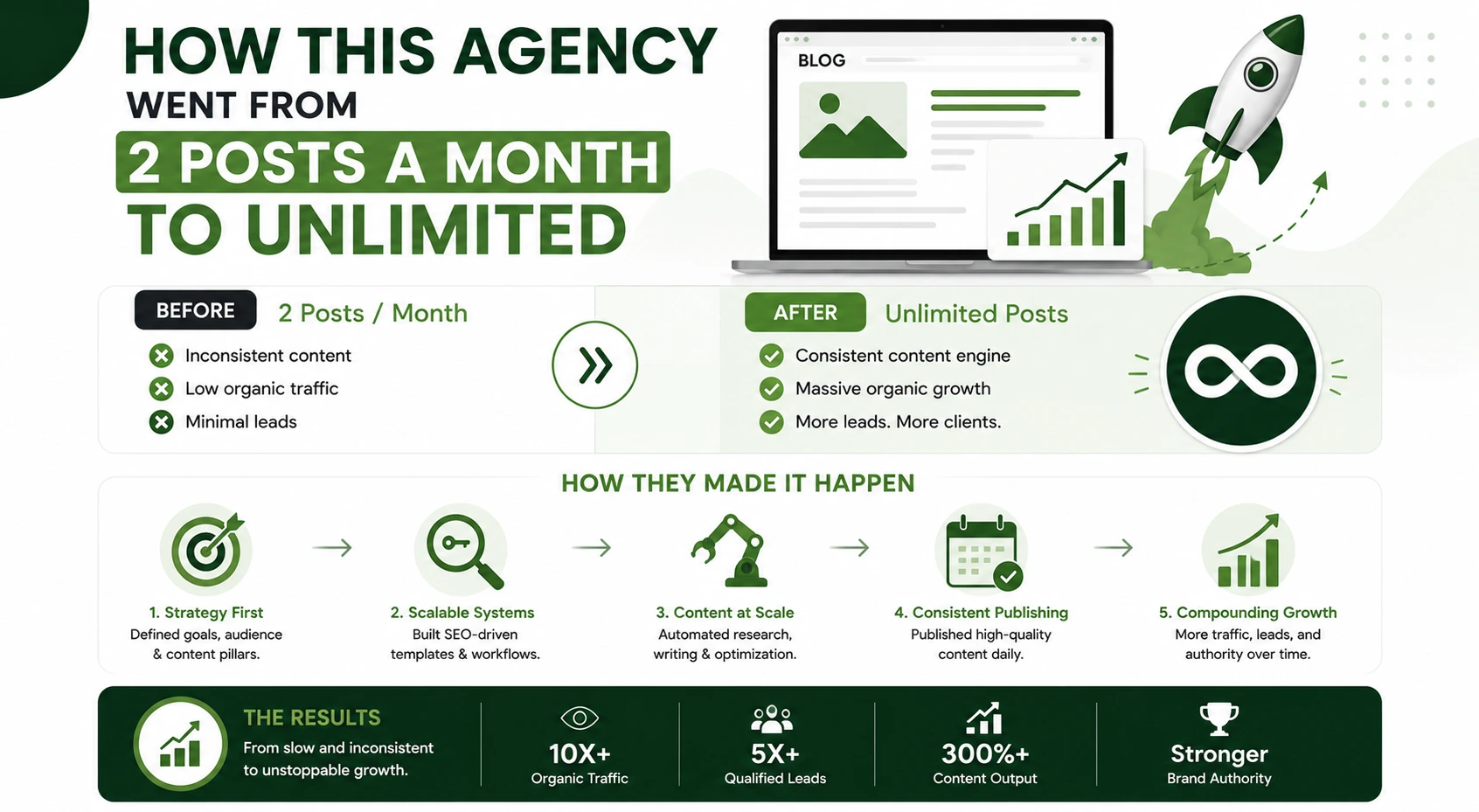
Within three months of full implementation, the agency's content output changed dramatically. Where client accounts were once capped at two posts a month by necessity, the team found they could scale output to match client demand instead of team bandwidth.
Metric | Before ContioReach | After ContioReach |
Average posts published per client, monthly | 2 | 8 to 12, scalable further |
Time to publish a single post | 6 to 8 hours | Under 2 hours |
New clients onboarded without new hires | 0 | 5 |
Editorial team overtime hours, weekly | High | Reduced significantly |
Sarah is careful to note that these figures reflect her agency's specific workflow and client mix, and results will vary by team size and content complexity. Even so, the shift was significant enough that the agency began actively pursuing new clients again, something they had avoided for nearly a year.
"We went from turning clients away to actively pitching new business," Sarah says. "That is the real difference. It was not just about publishing faster. It was about being able to say yes again."
What This Case Study Reveals About Content Automation Gaps
Many content teams assume automation means sacrificing quality or brand consistency for speed. This case study suggests the opposite is possible when the right platform handles the repetitive groundwork while leaving strategy and editing in human hands.
The gap most content automation approaches leave unaddressed is the disconnect between individual tools. A keyword tool that does not talk to a writing tool, which does not talk to a publishing tool, still leaves teams stitching workflows together manually. Sarah's experience points to a simple truth: real content automation is about the whole pipeline working as one system, not a collection of separate shortcuts.
For agencies stuck at a similar ceiling, whether that is two posts a month or twenty, the lesson from this content automation case study is the same. The constraint is rarely talent or client demand. It is almost always the workflow underneath.
Why Most Content Automation Stories Leave Out the Real Details
Plenty of articles on content automation stop at vague promises: faster output, happier clients, better rankings. What they usually skip is the actual mechanics of how a team's day-to-day workflow changes, and what results genuinely look like once the initial excitement wears off.
This content automation case study intentionally includes the parts most stories leave out. It shows the specific workflow stages that changed, the realistic timeline for seeing results, and an honest acknowledgment that outcomes depend on a team's size and client mix rather than promising identical results for everyone. That level of transparency is rare, and it is exactly what agency leaders need before committing to a new workflow.
It also matters that this case study reflects the kind of real, common workflow bottleneck agencies actually face, rather than a hypothetical scenario built around a specific tool's feature list. Teams like Sarah's do not adopt ContioReach because a feature list looks impressive on paper. They adopt it because it solves the specific operational bottleneck that generic advice never addresses: the disconnect between research, writing, SEO checks, and publishing that forces teams to stitch their own workflow together by hand.
Is Content Automation Right for Your Agency
If your team recognizes any part of Sarah's story, capping client intake, watching writers burn out on repetitive tasks, or losing hours to manual keyword research and formatting, it may be worth evaluating whether your current workflow is the actual bottleneck.
ContioReach was built specifically for teams facing this exact challenge, combining keyword research, brand voice consistency, SEO scoring, and publishing into a single workflow rather than a patchwork of disconnected tools.
The Bottom Line
Sarah's agency did not solve their content bottleneck by working harder or hiring more people. They solved it by fixing the workflow that was quietly limiting everything else. If your team is stuck at a similar ceiling, ContioReach offers the same combination of keyword research, brand voice consistency, SEO scoring, and automated publishing that helped this agency go from two posts a month to unlimited.
Ready to see what your team could produce with the right workflow behind it? Explore ContioReach today and find out how much content your agency has been leaving on the table.
Every agency has a version of Sarah's story sitting somewhere in their workflow, a bottleneck that feels permanent simply because no one has had time to question it. This content automation case study is proof that the ceiling is not fixed. It just takes the right system to move it.
Frequently Asked Questions
How long does it take to see results from content automation? Based on this case study, the agency saw meaningful workflow improvements within the first few weeks, with full results developing over about three months as the team refined their process and expanded the rollout across more client accounts.
Does content automation reduce content quality? Not when implemented correctly. In this case, quality checks were built into the workflow itself through automated SEO scoring, rather than removed from it, and human editors still reviewed every post before it reached a client.
Can small agencies benefit from this approach, or only large ones? Sarah's agency was mid-sized, not enterprise scale, and still saw significant results. The core benefit, removing repetitive manual work so writers can focus on strategy, applies regardless of agency size or client volume.
What is the biggest change teams notice first? Most teams notice time savings on research and formatting first, since those tasks disappear almost immediately. Brand voice consistency and the ability to scale output tend to become clear over the following weeks, once more posts have gone through the full workflow.
Does switching workflows disrupt existing client work? Sarah's team avoided disruption by piloting the new workflow on two accounts before expanding it. That gradual approach let them catch issues early without risking quality on client-facing work.
Written by

Team Contioreach
Creates expert content on SEO, AI search, content strategy, and automation to help businesses grow their online visibility.