 ChatGPT
 Perplexity
 Claude
 Grok
GrokA coding framework is a pre-built collection of code, tools, and conventions that gives developers a reusable foundation for building software instead of starting from scratch. It handles repetitive, low-level tasks like routing, database connections, and security so developers can focus on the logic unique to their application. Frameworks exist for nearly every language and use case, from web apps to mobile apps to machine learning. Popular examples include React, Django, and Laravel. This guide breaks down the main types of coding frameworks, why teams use them, and how to pick one.
What Does a Coding Framework Actually Do
A coding framework provides the skeleton of an application so you do not have to write every piece of infrastructure yourself. Think of it as a partially built house: the foundation, walls, and plumbing are already in place, and you focus on the rooms that make the house yours.
Most frameworks give you a folder structure, a set of reusable functions or classes, and rules for how different parts of your code should talk to each other. That structure is called an architecture pattern, and many frameworks follow one called Model-View-Controller (MVC), which separates data, display logic, and user interaction into distinct layers.
Here's the practical effect: instead of writing custom code to handle a user login form, validate the input, and store it securely in a database, a framework typically already has building blocks for all three. You wire them together and adjust them to your needs.
Framework vs Library: What Is the Difference
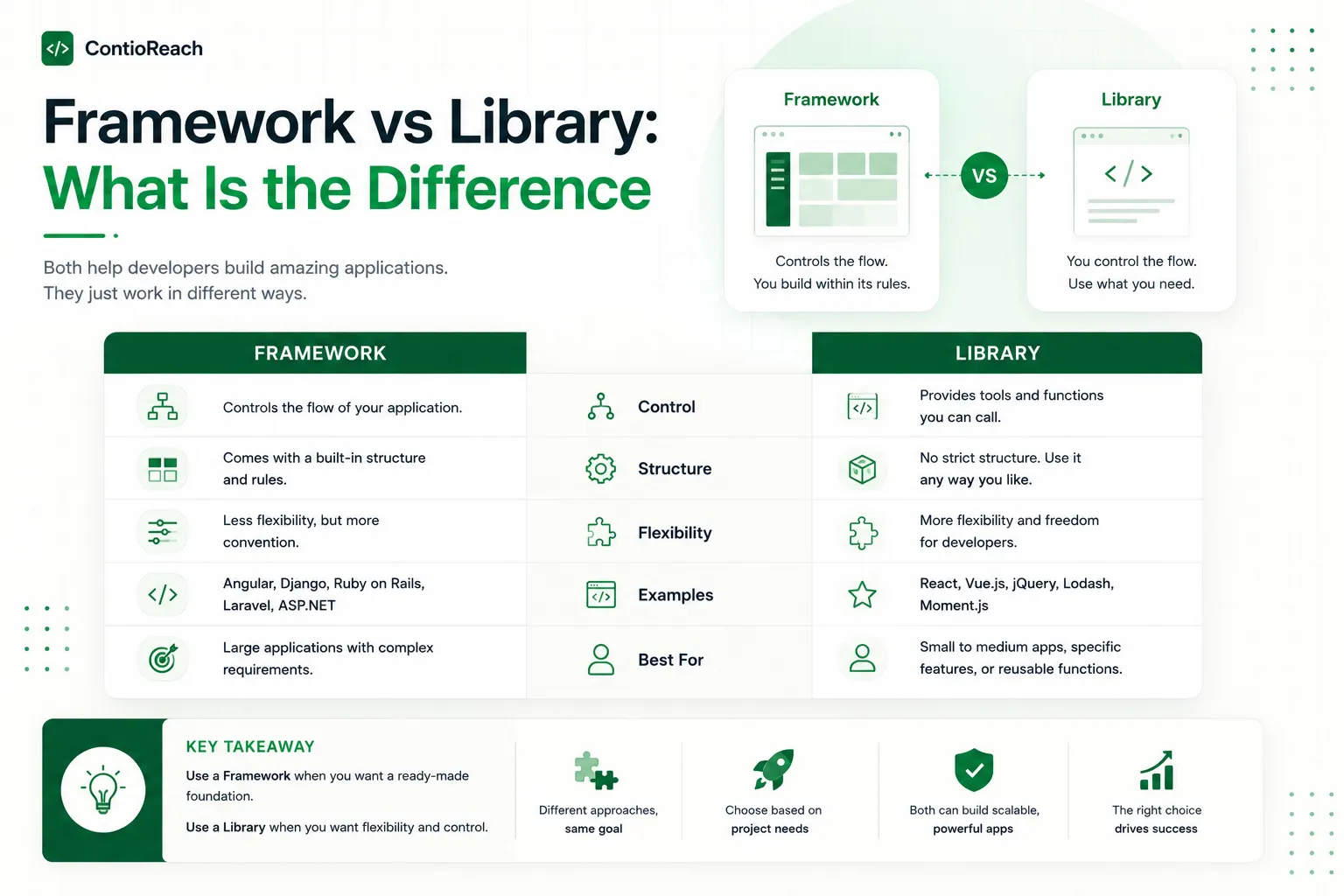
The core difference is who is in control of the program's flow. A library is a piece of code your application calls when it needs something, while a framework calls your code when it needs something. This is often called inversion of control.
With a library, like a date-formatting tool, you decide when and how to use it inside code you fully control. With a framework, you plug your code into slots the framework defines, and the framework decides when to run it.
Neither approach is better in every case. Libraries offer more flexibility for small or highly custom projects, while frameworks offer more structure and speed for larger applications built by teams.
Aspect | Library | Framework |
|---|---|---|
Who controls flow | Your code | The framework |
Flexibility | High | Moderate to low |
Setup time | Minimal | Higher upfront |
Best for | Specific tasks | Full applications |
Example | Lodash, Axios | Django, Laravel |
Types of Coding Frameworks
Coding frameworks fall into several broad categories depending on what kind of software they help you build. Most developers will encounter at least three or four of these over a career.

Below is a breakdown of the main types, what each one is used for, and where you're most likely to see it in real projects.
Web Development Frameworks
Web frameworks handle the parts of building a website or web app that repeat across nearly every project: routing URLs, managing sessions, rendering pages, and talking to a database.
They split further into front-end frameworks, which run in the browser and control what users see and interact with, and back-end frameworks, which run on a server and handle data, business logic, and security.
Front-end examples: React, Angular, Vue.js
Back-end examples: Django, Ruby on Rails, Laravel, Express.js
Mobile Development Frameworks
Mobile frameworks let developers build apps for iOS and Android, often from a single codebase instead of writing separate native apps for each platform.
This approach is called cross-platform development, and it can cut development time significantly because the same code runs on both operating systems with minor adjustments.
React Native
Flutter
Ionic
Data Science and Machine Learning Frameworks
These frameworks provide pre-built tools for handling large datasets, training models, and running statistical analysis, so data scientists do not need to write low-level math operations by hand.
They're built for tasks like image recognition, natural language processing, and predictive analytics, and they typically include optimized code for running on specialized hardware like GPUs.
TensorFlow
PyTorch
scikit-learn
Testing Frameworks
Testing frameworks give developers a standard way to write and run automated checks that confirm code behaves as expected before it ships.
They catch bugs earlier, make it safer to change existing code, and are considered a core part of professional software development practice.
Jest
Selenium
PyTest
Benefits of Using a Coding Framework
The biggest benefit of a coding framework is speed. Developers spend less time building infrastructure and more time on features that actually differentiate the product.
That said, speed is only part of the story. Frameworks also improve consistency and long-term maintainability, especially once more than one developer touches the code.
Faster development: Pre-built components and boilerplate code mean less time spent on repetitive setup work.
Consistent structure: A shared architecture makes it easier for new developers to understand an existing codebase.
Built-in security: Established frameworks often include protections against common vulnerabilities like SQL injection and cross-site scripting by default.
Community support: Popular frameworks have large communities, so documentation, tutorials, and troubleshooting help are easy to find.
Easier maintenance: Standardized patterns make it simpler to update, debug, or hand off code to another team.
Common Drawbacks to Know About
Frameworks are not free of trade-offs. The same structure that speeds up development can also limit flexibility when a project needs something the framework was not designed for.
There's also a learning curve. A developer fluent in a language still needs time to learn a specific framework's conventions, folder structure, and quirks before becoming productive.
Learning curve: Each framework has its own rules, terminology, and best practices to master.
Overhead: Frameworks can include more code and dependencies than a small project actually needs.
Lock-in risk: Rebuilding an application in a different framework later can require significant rework.
Version churn: Frameworks update frequently, and keeping dependencies current takes ongoing maintenance.
How to Choose the Right Coding Framework
The right framework depends on what you're building, not on which one is trendiest. A marketing landing page and a real-time trading platform have very different needs.
Start by matching the framework's purpose to your project type, then narrow down based on team experience and long-term support.
Define the project type: Confirm whether you need a web app, mobile app, API, or data pipeline before comparing options.
Check team familiarity: A framework your team already knows is often faster to ship with than a technically superior but unfamiliar one.
Evaluate community and documentation: Active communities and clear docs make troubleshooting far easier down the line.
Consider scalability: Confirm the framework can handle your expected traffic and future feature growth.
Review long-term support: Favor frameworks with a track record of regular updates and security patches.
Coding Frameworks vs Programming Languages
A programming language is the actual language you write code in, such as JavaScript, Python, or PHP. A framework is built using that language and gives you tools, structure, and conventions on top of it.
Put simply: the language is the raw material, and the framework is a pre-assembled kit made from that material. You can write Python without Django, but Django cannot exist without Python underneath it.
This is why the same language often has multiple competing frameworks. Python developers might choose Django for a full-featured web app or Flask for something lighter, while still writing the same underlying language.
Frameworks and Content Publishing Tools
Frameworks aren't limited to building applications from scratch. Many modern content and marketing tools are themselves built on top of coding frameworks, which is part of why they can integrate cleanly with developer-built sites.
For teams publishing content on custom-built sites, this matters directly. Next.js, a popular React-based framework, is a common choice for teams pairing a headless CMS like ContioReach with a fast, SEO-friendly front end. Understanding how frameworks work makes it easier to follow a getting started guide for connecting a CMS to your chosen stack.
Frequently Asked Questions

What is a coding framework in simple terms?
A coding framework is a pre-built set of code and tools that gives developers a starting structure for an application, instead of building everything from zero. It handles common tasks like routing and database access so developers can focus on custom features unique to their project.
Is a coding framework the same as a library?
No. A library is code your application calls when needed, while a framework calls your code and controls the overall flow of the program. Frameworks are typically larger in scope and dictate more of an application's structure than a library does.
What is the most popular coding framework?
React is widely considered the most popular front-end framework, primarily for building user interfaces in JavaScript. On the back end, frameworks like Django, Laravel, and Express.js are among the most widely used across professional projects.
Do beginners need to learn a framework?
Beginners should first learn the core programming language before moving to a framework, since frameworks assume a working knowledge of that language's fundamentals. Once comfortable with the basics, learning a framework helps beginners build real projects faster and follow industry-standard practices.
Is a coding framework free to use?
Most popular coding frameworks, including React, Django, and Laravel, are free and open source. Some enterprise-focused frameworks or paid add-ons exist, but the majority of widely used frameworks carry no licensing cost.
How long does it take to learn a coding framework?
Learning the basics of a framework typically takes a few weeks of consistent practice for someone who already knows the underlying language. Reaching genuine proficiency, including its ecosystem and best practices, usually takes several months of hands-on project work.
Can you build an app without a framework?
Yes, it's possible to build an app writing every piece of code manually, sometimes called a “vanilla” approach. This gives maximum control but takes significantly longer and requires rebuilding common functionality that a framework would otherwise provide.
What is the difference between a frontend and backend framework?
A front-end framework controls what users see and interact with in the browser, such as React or Vue.js. A back-end framework runs on the server and manages data, business logic, and security, such as Django or Laravel.
Key Takeaway
A coding framework is a pre-built foundation of code and tools that speeds up software development by handling common, repetitive tasks. Choosing the right one comes down to matching its purpose, whether web, mobile, data science, or testing, to what you're actually building.
Frameworks trade some flexibility for speed, consistency, and community support, which is why they power most professional software today. If you're building or publishing content on a framework-based site, explore how ContioReach's auto-publish tools connect directly to modern web frameworks to move content live faster.
Written by
Team Contioreach
Creates expert content on SEO, AI search, content strategy, and automation to help businesses grow their online visibility.