
 ChatGPT
 Perplexity
 Claude
 Grok
GrokHow often should you blog if you run a SaaS company? This is one of the most common questions marketing teams ask, yet most answers online are based on opinion rather than evidence. The right publishing frequency depends on your blog's maturity, competitive landscape, and content quality standards, not an arbitrary weekly quota.
At ContioReach, we have published more than 10,000 blog posts spanning early-stage startups to established SaaS platforms, giving us a clear view into the publishing cadence that actually drives organic growth. This guide breaks down a practical, data-backed framework for deciding how often your SaaS blog should publish, and how to build a content calendar that scales with your business.
Why "How Often Should You Blog" Doesn't Have One Right Answer
Search engines do not reward posting frequency by itself. Google has said many times that content quality, relevance, and search intent matter far more than how many articles you publish in a month. A SaaS company that publishes two exceptional, well-researched posts a month will often outperform one that publishes ten mediocre posts in the same window.
That said, frequency still matters, just not in the way most people think. It matters because:
More consistent publishing gives search engines more signals about your site's topical authority.
A steady cadence keeps your brand visible to returning readers, email subscribers, and social followers.
Regular publishing forces your team to build a repeatable, sustainable content process instead of relying on sporadic bursts.
It compounds. SEO traffic is not linear. Posts published 12 months ago can still be driving the bulk of your organic traffic today, and the more strong posts you have in the pipeline, the faster that compounding effect kicks in.
So the real question is not "how many posts per week," but "what is the minimum sustainable frequency that keeps your topical authority growing without sacrificing quality."
What the Data Actually Shows
Drawing from the volume of SaaS content ContioReach has produced and analyzed, a few patterns show up again and again.
Early-stage SaaS blogs (0 to 20 posts published) see the fastest gains from consistency, not volume. New blogs need to establish a base of indexed, well-optimized pages before frequency starts to matter much. At this stage, publishing one strong post a week, every week, for three to six months tends to outperform sporadic bursts of five posts in one month followed by silence.
Mid-stage SaaS blogs (20 to 150 posts) benefit most from a mix of frequency and content type diversity. This is the stage where topic clusters start to form, and posting two to four times per week (spread across top, middle, and bottom-funnel content) tends to produce the strongest compounding traffic growth.
Mature SaaS blogs (150-plus posts) see diminishing returns from raw frequency and much higher returns from updating and refreshing older content. At this stage, a smart move is often shifting 30 to 40 percent of publishing effort into updating existing posts rather than only publishing new ones.
Below is a simplified breakdown of how frequency recommendations tend to shift as a SaaS blog matures.
Recommended Blogging Frequency by SaaS Blog Stage
Blog Stage | Posts Published So Far | Recommended Frequency | Primary Goal |
Early stage | 0 to 20 posts | 1 post per week | Build indexed pages and topical foundation |
Growth stage | 20 to 150 posts | 2 to 4 posts per week | Expand topic clusters and capture more keywords |
Mature stage | 150-plus posts | 1 to 2 new posts per week, plus regular content refreshes | Maintain rankings and improve conversion on existing traffic |
Enterprise-scale content ops | 500-plus posts | 2 to 5 posts per week, mixing new content and refreshes | Defend rankings and expand into new markets |
This is a general framework, not a rigid rule. A SaaS company targeting a narrow, low-competition niche may need far less volume than a SaaS company competing in a crowded space like project management software or CRM tools.
The Factors That Should Actually Decide Your Frequency
Instead of picking a number out of thin air, base your publishing frequency on these factors.
1. Your competitive landscape. If your target keywords are dominated by well-established sites with hundreds of ranking pages, you will likely need higher output to compete. If you are in a niche with less content saturation, quality and consistency will get you further than sheer volume.
2. Your team's capacity for quality control. A rushed, thin post published just to hit a quota can actively hurt your domain's perceived quality. It is better to publish four excellent posts a month than twelve rushed ones.
3. Your funnel coverage. SaaS blogs often over-invest in top-funnel content and neglect middle and bottom-funnel posts that actually drive trial signups and demo requests. Frequency should be planned around funnel balance, not just top-funnel keyword volume.
4. Your resources for promotion and distribution. Publishing without a distribution plan, email, social, internal linking, means even great content can sit unseen. If your team cannot promote every post well, it is better to publish less often and promote each piece properly.
5. Your internal linking and content refresh strategy. New posts perform better when they link to and from existing content. A high-frequency strategy without strong internal linking often underperforms a lower-frequency strategy with excellent site architecture.
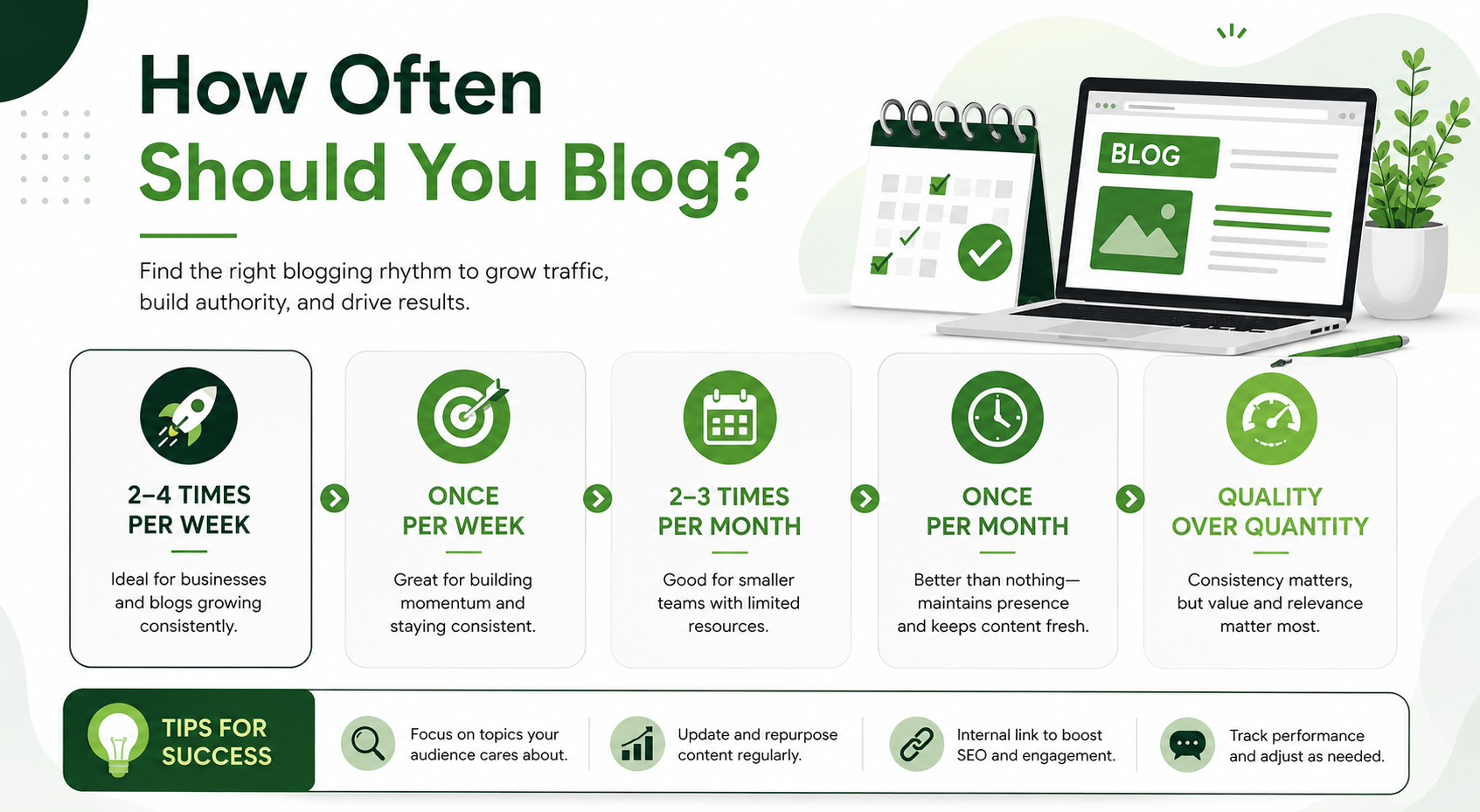
Quality vs. Quantity: What Actually Wins in 2026
The debate between quality and quantity is a bit of a false choice. The real answer is quality at a sustainable frequency. Search engines have become significantly better at identifying thin, AI-generated filler content, and SaaS buyers are more skeptical than ever of generic advice.
What tends to work well for SaaS blogs today:
Original data, case studies, or proprietary insights (like the kind ContioReach draws from its own client work)
Clear, specific answers to real buyer questions instead of vague overviews
Strong internal linking to product pages and related articles
Content that is updated on a regular schedule, not published once and forgotten
A blog that publishes less often but consistently delivers original insight, practical takeaways, and strong formatting will almost always outperform a blog that publishes daily but recycles the same generic talking points found everywhere else online.
Content Type Mix and Suggested Cadence for SaaS Blogs
Content Type | Funnel Stage | Suggested Share of Content Calendar | Suggested Frequency |
Educational or how-to posts | Top-funnel | 40 percent | Weekly or biweekly |
Data-backed or opinion posts | Top-funnel | 15 percent | Monthly |
Comparison and use-case posts | Middle-funnel | 20 percent | Biweekly or monthly |
Product-led or feature-focused posts | Bottom-funnel | 15 percent | Monthly |
Content refreshes and updates | All stages | 10 percent | Ongoing, monthly review cycle |
This kind of balanced calendar helps SaaS teams avoid the common trap of publishing only top-funnel content, which drives traffic but often fails to convert readers into trial users or demo requests.
How ContioReach Helps SaaS Teams Get Frequency Right
Deciding on the right blogging frequency is only half the battle. Actually sustaining it, month after month, with content that holds up in search rankings and reads well to real buyers, is where most in-house teams struggle.
This is exactly where ContioReach comes in. Having published more than 10,000 blog posts for SaaS and B2B tech clients, our team has built a repeatable system for figuring out the right cadence for each client's specific market, competition level, and growth stage, rather than applying a one-size-fits-all publishing schedule.
Here is what that looks like in practice with ContioReach:
A frequency plan based on your actual competitive data, not guesswork. We analyze your niche, your current content footprint, and your competitors' publishing patterns to recommend a realistic, sustainable cadence.
A balanced content calendar that mixes top, middle, and bottom-funnel content so your blog drives both traffic and conversions, not just pageviews.
A dedicated content refresh process, so older posts keep performing instead of quietly losing rankings over time.
SEO-optimized, well-researched writing at the volume your growth stage actually calls for, whether that is one post a week or five.
Internal linking and on-page optimization built into every post, so new content strengthens your existing pages instead of competing with them.
If you are unsure whether your current publishing frequency is helping or hurting your SaaS growth, ContioReach can audit your existing blog, benchmark it against your market, and build a content plan designed around real data rather than industry guesswork.
Not sure where your blog stands? Get a free content audit from ContioReach and see exactly how your publishing frequency compares to your market.
The Bottom Line
There is no single magic number for how often a SaaS blog should post. What the data consistently shows is that sustainable consistency, paired with strong content quality and smart funnel coverage, outperforms both sporadic publishing and rushed, high-volume publishing.
Start with a frequency that matches your current blog stage, build in a mix of top, middle, and bottom-funnel content, and treat older posts as assets worth maintaining, not one-time projects.
If you want a publishing cadence built around real data instead of guesswork, ContioReach can help. Backed by lessons learned from over 10,000 SaaS and B2B blog posts across dozens of niches, our team can audit your current content, benchmark your market, and build a sustainable content plan that grows both your traffic and your pipeline.
Frequently Asked Questions
How long does it take to make $1000 per month blogging?
It varies by niche and monetization method, but for SaaS blogs focused on trial signups or demos, most brands start seeing meaningful lead generation within four to nine months of consistent, buyer-intent-focused publishing.
Is blogging still worth it in 2026?
Yes. Despite a more competitive landscape, original, well-researched blog content still drives strong organic traffic, trust, and lead generation for SaaS brands.
Is one blog post a week enough?
For early and growth-stage SaaS blogs, one high-quality post per week is a solid baseline. More competitive niches or mature blogs may need higher frequency or added content refreshes.
How often do successful bloggers post?
Most successful SaaS and B2B bloggers publish one to four times per week. Consistency, topic coverage, and content refreshes matter more than any exact number.
Ready to build a blogging strategy that actually drives growth? Reach out to ContioReach today and let's map out the right content cadence for your SaaS business.
Written by

Team Contioreach
Creates expert content on SEO, AI search, content strategy, and automation to help businesses grow their online visibility.