
 ChatGPT
 Perplexity
 Claude
 Grok
GrokEvery content team eventually hits the same expensive assumption: more output requires more writers. Traffic goals climb, the keyword list grows, and the instinct is to post a job. Then reality sets in. Hiring takes months, freelancers bring inconsistent quality, and every new writer needs training before they're actually productive. Meanwhile the backlog keeps growing.
Here's the part most teams miss. The bottleneck usually isn't a shortage of people who can write. It's a shortage of systems. Most of the content pipeline, drafting, formatting, images, publishing, is mechanical work that doesn't need a human repeating it by hand. Fix that, and output scales without headcount.
Why Hiring More Writers Doesn't Scale the Way You Think
Adding headcount feels like the natural solution because it's the most visible lever. More writers, more articles, more traffic. In practice, it runs into three problems almost every team eventually hits.
Cost scales faster than output:
A full time writer costs a salary, benefits, management time, and training before they produce anything close to their eventual output. Freelancers solve the ramp up problem but introduce inconsistency in voice, quality, and turnaround time, and every new freelancer needs a brief, edits, and feedback cycles before they're reliable.
Coordination overhead grows with the team:
Every additional writer means more editorial calendar management, more style guide enforcement, more back and forth on drafts. At a certain point, the people managing writers are spending more hours coordinating than the writers spend writing.
Quality becomes harder to control, not easier:
More people writing content means more variation in tone, structure, and SEO discipline. Without a system to standardize output, a bigger team can actually produce a less consistent blog than a smaller one.
None of this means writers aren't valuable. It means the bottleneck usually isn't a shortage of people who can write sentences. It's a shortage of systems that turn a keyword list into a published, optimized article without someone manually touching every step.
To put real numbers behind this, here's how the common ways of producing content actually compare on cost.
Production Method | Typical Cost | What It Covers | Main Limitation |
In house writer (salary) | Median $72,270/year, $101,000 to $108,000 fully loaded with benefits, recruiting, and onboarding | Full time capacity, brand consistency over time | Fixed cost regardless of publishing volume that month |
Freelance writer | Average $53/hour or $0.42/word, roughly $250 to $399 for a 1,500 word post | Flexible volume, no long term commitment | Costs scale linearly with every additional article |
Content agency or retainer | Typically higher per article than solo freelancers once account management is included | Editorial oversight, multiple writers | Least control over voice and turnaround per piece |
Automated pipeline (e.g. Auto-Publish) | Flat platform cost regardless of article count within plan limits | Drafting, SEO formatting, cover images, and scheduling for a defined content queue | Best suited to repeatable formats, not highly specialized or investigative pieces |
The point of this table isn't that one method is universally correct. It's that cost in content production usually scales with volume unless a step in the pipeline is automated, at which point volume stops being the thing driving the bill.
The Real Bottlenecks in Content Production
Before fixing anything, it helps to separate content production into its actual stages, because "we need more content" usually hides a much more specific problem.
Ideation and keyword selection. Someone has to decide what to write about, check search volume and intent, and prioritize. This is strategic work, and it's the one stage that genuinely benefits from a human who understands the business.
Drafting. Turning a keyword and a brief into a full article. This is the stage most teams associate with "content production," and it's also the most mechanically repeatable part of the process once your tone and structure are defined.
Formatting and optimization. Headings, meta descriptions, internal links, readability, keyword placement. This is rules based work. It follows a pattern every time, which makes it a strong candidate for automation.
Cover images and visual assets. Every published post needs a featured image sized correctly for your site and social sharing. Done manually, this is a small task repeated hundreds of times a year, which adds up to real hours.
Scheduling and publishing. Getting content live at the right time, in the right category, with the right tags, and making sure the frontend actually reflects the new post.
Distribution and internal linking. Making sure new content connects to existing content so search engines and readers can actually find it.
When you break the pipeline down this way, it becomes clear that only the first stage truly requires ongoing human judgment for every single piece. The rest is process, and process can be systemized.
Build the System Before You Add People
The teams that scale content output without ballooning headcount tend to follow the same pattern, regardless of industry.
Step 1: Build a real keyword queue, not a wish list. Instead of assigning topics one at a time, import your target keywords with search volume, competition, and intent all at once. Tag and prioritize them so there's always a ranked backlog ready to go, rather than a scramble every week to figure out what's next.
Step 2: Define your voice once, not per article. A writing preset that captures your tone, structure, typical length, and formatting conventions means every piece of content starts from the same foundation. This is the single highest leverage thing a content team can do, because it's the difference between reviewing drafts for quality and rewriting drafts for consistency.
Step 3: Set a publishing cadence and stick to it. Google and readers both reward consistency. A queue of great articles that get published sporadically performs worse than a steady cadence of solid articles published on schedule. Decide on daily, weekly, or custom frequency, and build your workflow around hitting it automatically rather than manually remembering to post.
Step 4: Let optimization happen at the point of creation, not after. Waiting until a draft is finished to check keyword placement, meta descriptions, and heading structure means rework. Systems that surface SEO recommendations while content is being generated save the editing pass entirely.
Step 5: Automate the mechanical steps, and keep humans on strategy. This is where most teams get the balance wrong. They either try to automate everything, including the strategic keyword decisions that need business context, or they refuse to automate anything, including the repetitive formatting and publishing work that doesn't need a person at all.
Where Auto-Publish Fits
This is exactly the gap that Auto-Publish Content, part of the ContioReach platform, is built to close.
Instead of treating content production as a series of manual handoffs, Auto-Publish turns your keyword queue into a running content pipeline. You import your target keywords with search volume, intent, and difficulty already attached, and tag the ones you want prioritized. You choose a writing preset that defines tone, language, length, and structure once, so every article that comes out of the queue matches your brand voice without a separate review pass for consistency. Then you set a publishing frequency, daily, weekly, or custom, and set a time.
From there, at each scheduled run, the system picks the next keyword in your queue, generates a full SEO optimized article, applies your cover image template automatically so every post gets a properly sized featured image with the title baked in, and publishes it, all without manual input. There are no drafts sitting in a queue waiting for someone to remember to hit publish, and no separate formatting step before a piece goes live.
Because ContioReach is a fully headless CMS, the published content is available through a single API, so your existing frontend, whether that's Next.js, React, or another framework, can pull posts, authors, tags, and categories directly, with a webhook firing on every publish so your site updates instantly.
For agencies or teams managing more than one brand, this same system supports multiple isolated workspaces, each with its own keyword list, writing preset, brand voice, and publishing schedule, so one person can oversee content production across several clients without switching tools or losing track of what's queued where.
The result is that the mechanical middle of the content pipeline, the drafting, formatting, image creation, and publishing, runs on its own schedule, while your team's time goes toward the parts of content strategy that actually require a human decision: which keywords matter most, what your brand should sound like, and how the content ties back to business goals.
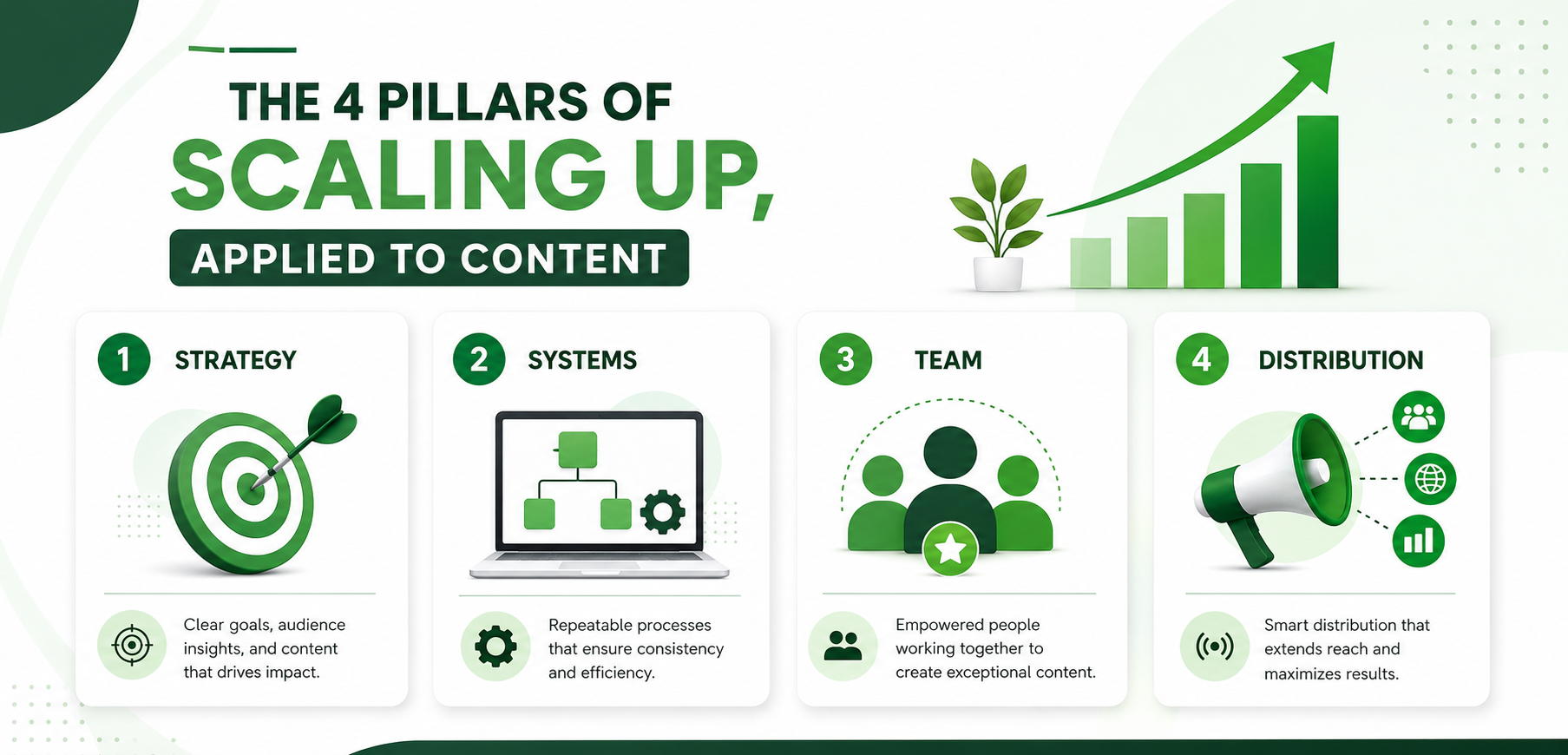
The 4 Pillars of Scaling Up, Applied to Content
Business growth expert Verne Harnish popularized a widely used framework for scaling any part of a business: People, Strategy, Execution, and Cash. It maps cleanly onto a content operation, and it's a useful check before you decide whether the answer to "we need more content" is another hire or a better system.
Pillar | What It Means for a Business | What It Means for Content Production |
People | Hiring, culture, and leadership development | Who owns keyword strategy, brand voice, and quality control, not who writes every draft by hand |
Strategy | A clear, differentiated plan for growth | A prioritized keyword queue tied to actual search intent and business goals |
Execution | Turning strategy into consistent daily action | A publishing cadence and workflow that runs whether or not someone remembers to hit publish |
Cash | Managing the resources that fuel growth | Cost per published article, and whether that cost scales with volume or stays flat |
Read this way, scaling content production is the same problem as scaling any other part of a business: it fails when one pillar, usually Execution, depends entirely on manual effort that doesn't grow with demand.
What to Keep Human, Even When You Automate the Rest
Scaling content production responsibly doesn't mean removing people from the process. It means being deliberate about where their time goes.
Keyword strategy still needs a person who understands the business, the competitive landscape, and what "good" actually looks like for your audience. Brand voice, once defined, should be revisited periodically as your positioning evolves. And published content still benefits from a human occasionally spot checking output, especially for anything touching pricing, claims, or sensitive topics, even when the day to day generation and publishing runs automatically.
The goal isn't a content operation with zero human involvement. It's a content operation where every hour a person spends is spent on a decision that actually needed a person, while the repeatable, rules based work runs in the background on its own.
The Bottom Line
Scaling content production without hiring more writers isn't about working harder or squeezing more output from the writers you already have. It's about recognizing that most of the content pipeline, from formatting to image generation to scheduling to publishing, is mechanical work that doesn't require a person to repeat manually hundreds of times a year.
Build a real keyword queue, define your voice once, set a consistent publishing cadence, and let a system like Auto-Publish handle the repeatable middle of the pipeline. Your team's time goes toward strategy instead of formatting, and your publishing frequency stops being limited by how many people you can afford to hire.
People Also Ask
What are the 4 pillars of scaling up?
From Verne Harnish's "Scaling Up": People, Strategy, Execution, and Cash. Applied to content, that's who owns quality and voice, which keywords you prioritize, whether your publishing cadence actually runs, and whether cost per article scales with volume.
Is AI going to replace content writers?
Not entirely, and not on a settled timeline. AI already handles drafts, formatting, and repetitive SEO tasks well. Strategy, audience judgment, and editorial nuance are harder to automate, so most expect writers to shift toward editing and directing AI output rather than disappearing. People in the industry genuinely disagree on how fast that shift goes.
Are content writers still in demand?
Yes, but the role is shifting. Fewer pure drafting jobs, more reviewing, directing, and editing of machine generated content. Writers with strategic and editorial skills remain in high demand.
How much does it cost to hire a content writer?
A full time in-house writer runs a median $72,270/year, or $101,000 to $108,000 fully loaded with benefits and hiring costs. Freelancers average $53/hour or $0.42/word, with a typical 1,500 word post at $250 to $399. Agencies usually cost more per article once account management is included.
Written by

Team Contioreach
Creates expert content on SEO, AI search, content strategy, and automation to help businesses grow their online visibility.